
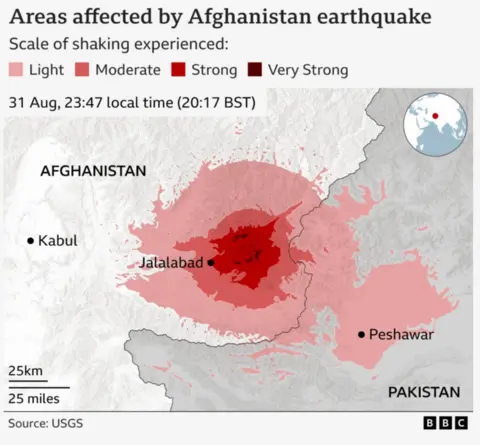
In brief
A powerful 6.0 magnitude earthquake has struck eastern Afghanistan, resulting in the death of approximately 800 individuals and injuring around 1,800 more. Rescue teams are conducting aerial searches for survivors amidst challenging terrain and debris-blocked roads. The Taliban government has called for international assistance, with initial responses from the UN and the UK. The disaster strikes as Afghanistan battles severe drought and a hunger crisis, exacerbating the dire humanitarian situation.
Rescuers on helicopters are searching the ruins of remote villages in eastern Afghanistan for survivors of a powerful earthquake that has killed 800 people and injured 1,800 others.
Many are feared trapped under the rubble of their homes after the magnitude 6.0 earthquake struck on Sunday near the country's border with Pakistan.
Authorities searched by air for the second day on Tuesday as roads blocked with debris and the mountainous terrain in the affected areas made land travel difficult.
The Taliban government has appealed for international help. The UN has released emergency funds, while the UK has pledged £1m ($1.3m) in aid.
Sunday's earthquake was one of the strongest to hit Afghanistan in recent years. The country is very prone to earthquakes because it is located on top of a number of fault lines where the Indian and Eurasian tectonic plates meet.
In 2023, more than 1,400 people died after a series of 6.3-magnitude earthquakes hit western Afghanistan, near the city of Herat.
Survivors of Sunday's earthquake were brought to a hospital in Jalalabad, which has been overwhelmed with hundreds of patients daily even before the disaster.
Mir Zaman told the BBC that he pulled his dead children out of the rubble by himself. It was dark. There was no light. Someone lent me a lamp, and then I used a shovel and pick axe to dig them out. There was no one to help because everyone was affected. So many people died in my village. Some are still buried. Whole families have died, he said.
Two-and-a-half-year-old Maiwand suffered head injuries and blood loss. You can see his situation. It's so tragic. The earthquake was deadly. I want the doctors to treat him, to cure him, said the child's uncle, Khawat Gul.
The most recent earthquake hit Afghanistan when it is reeling under severe drought and what the UN calls an unprecedented crisis of hunger.
The country has also experienced massive aid cuts especially from the US this year which is further reducing the aid that many of these people could have got. This disaster couldn't have come at a worse time.
Britain's Foreign Secretary David Lammy said aid from the UK will be channelled through experienced partners, the UN Population Fund (UNFPA) and the International Red Cross.
India delivered 1,000 tents to Kabul, its foreign minister Subrahmanyam Jaishankar wrote on X after speaking to his Taliban counterpart Amir Khan Muttaqi. The Indian mission is also helping to move 15 tonnes of food from Kabul to Kunar province, which has been badly hit by the earthquake, he said, adding that India would send more relief items.
China and Switzerland have also pledged support.
Survivors will need housing, shelter and blankets, said Amy Martin, who leads the United Nations Office for the Coordination of Humanitarian Affairs (OCHA) in Afghanistan.
