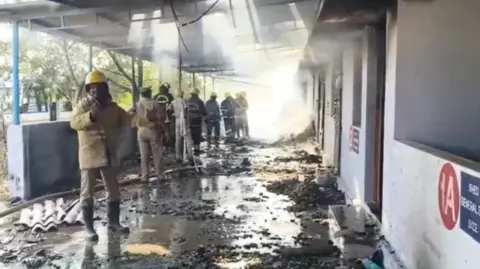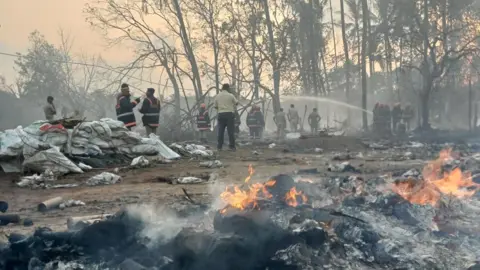
At least 13 people have been killed in an explosion at a firecracker factory in India's southern state of Kerala, officials say.
The incident took place in Thrissur, where around 40 people were believed to be assembling firecrackers in a cluster of sheds for an upcoming festival. Several others were injured, with five reported to be in critical condition.
This was the second such incident this week. On Sunday, a blast at a firecracker factory in neighbouring Tamil Nadu state left at least 25 dead.
Accidental explosions are a grim routine in India's fireworks industry, occurring with troubling regularity, especially around Sivakasi in Tamil Nadu, which produces much of the country's supply.
The explosion in Thrissur on Tuesday around 15:30 local time triggered secondary blasts that slowed rescue efforts. Firecrackers were being made in temporary sheds near paddy fields with poor road access, hampering emergency response. The force of the blast was felt kilometres away, causing nearby homes to be damaged.
Eyewitnesses described chaotic scenes as locals joined rescue efforts, pulling out injured and deceased individuals. Kerala's Revenue Minister K Rajan stated that all fireworks units preparing for the upcoming Thrissur Pooram - a major annual Hindu temple festival - had permission to manufacture and store fireworks in designated areas.
The workers in question were preparing fireworks for the Thiruvambady Temple, a vital part of the festival's climactic displays. Officials noted that food had been prepared for about 40 workers, and the cause of the explosion has yet to be determined, though extreme heat is suspected.
A magisterial inquiry has been ordered to establish the incident's circumstances and assign responsibility. Kerala Chief Minister Pinarayi Vijayan has stated that medical experts from other states would be available to treat burn victims as needed, while Prime Minister Narendra Modi announced financial assistance for the victims' families.
Firecracker factory accidents are common in India, where the industry - largely informal - is often associated with weak enforcement of safety standards. A study showed nearly 10,000 accidents in the Sivakasi region between 2003 and 2010 alone, including significant fatalities. The recent tragedies underline an urgent need for reforms to ensure worker safety and compliance with necessary regulations.