
In brief
Vladimir Putin's recent claims of Russia's advanced nuclear capabilities, including the Poseidon underwater drone and Burevestnik missile, have sparked concerns regarding their military viability and implications for global security. While some experts see the announcements as empty bravado, others suggest they reflect Russia's strategic positioning amid ongoing pressures from Ukraine. The context of U.S.-Russia relations adds another layer of complexity as President Trump responds with intentions to resume nuclear testing.
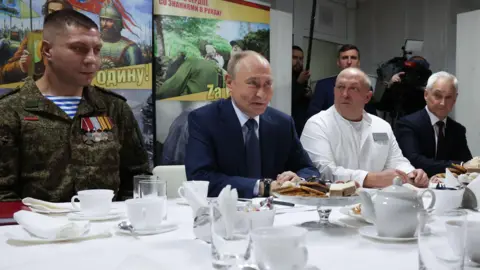
On Wednesday, over tea and cakes with veterans of the Ukraine war, President Vladimir Putin announced Russia had tested a new weapon. There is nothing like this, the Russian leader said of the Poseidon - a nuclear-powered, nuclear-capable underwater drone that can be fired like a torpedo and which a senior Russian MP said could put entire states out of operation.
When it was first unveiled in 2018, Russian media claimed the Poseidon could achieve a speed of 200km/h (120mph) and travel in a constantly changing route, making it nearly impossible to intercept. Putin's claim was made shortly after Moscow conducted a test of its unlimited-range Burevestnik nuclear-powered cruise missile, which he characterized as a unique product, unmatched in the world.
However, while Russia's military displays are not unusual, their actual military value remains ambiguous. Mark Galeotti, a Russia scholar, noted that these are essentially second-strike weapons—too powerful to be practically deployed without risk of global destruction. Concerns regarding their functionality also persist; past incidents, such as a rocket engine explosion linked to the Burevestnik, raised questions about the technical capabilities of these weapons.
The timing of these announcements, coinciding with stalled peace talks between the U.S. and Russia, points to a strategic maneuver. Analysts suggest Putin may be trying to capture Trump’s attention amid a backdrop of increased tensions and sanctions against Russia for its actions in Ukraine.
As the battlefield dynamics in Ukraine continue to evolve without a significant breakthrough for Russian forces, the announcement of these new weapons could be interpreted as an attempt to mask underlying military struggles. David Heathcote of McKenzie Intelligence Services opines that such revelations often coincide with weakening conventional forces, reflecting an inclination toward aggressive posturing.
The international response has been quick, with Trump indicating plans to resume U.S. nuclear testing, heightening fears of a renewed arms race. As such, while Putin's claims may resonate within a domestic context of patriotic displays, the overarching implications for global security remain complex and uncertain.
