
In brief
Ukrainian President Volodymyr Zelensky has firmly dismissed recent European proposals for establishing a buffer zone between Ukrainian and Russian forces. Citing the evolving nature of warfare and highlighting the already existing 'dead zone' due to drone technology, Zelensky argues that such measures misrepresent the current conflict's realities. He emphasized that the proposal would require Ukraine to give up territory, which he rejects, asserting that Russia should withdraw to its temporarily occupied territories. Meanwhile, ongoing diplomatic efforts led by the US appear to be dwindling in momentum as the conflict continues unabated.
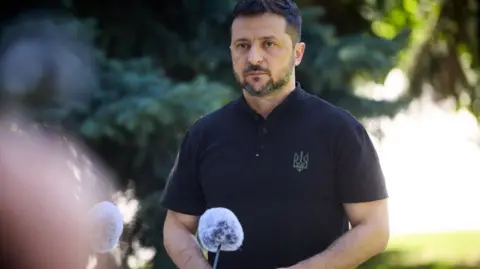
Ukrainian President Volodymyr Zelensky has rejected proposals for a buffer zone between Ukrainian and Russian forces as part of a peace deal, arguing it does not reflect the realities of modern warfare.
Only those who do not understand the technological state of today's war propose a buffer zone, he told reporters on Friday.
His comments followed a report suggesting European leaders were considering a 40km (25-mile) buffer zone as part of either a ceasefire or longer-term agreement.
The war in Ukraine has evolved into a conflict driven by drone technology, and Zelensky suggested a buffer zone of sorts already existed because of the threat of drone strikes close to the front line.
Buffer zones can create demilitarised zones between warring countries, such as North and South Korea, and physical boundaries such as the Iron Curtain - which separated the Soviet Union and the West following World War Two.
According to a report in Politico, European diplomats said the proposal among military and civilian officials was for a strip of land in Ukraine to be blocked off between the two forces.
But Zelensky said there already was an area on either side of the front line where heavy artillery was unable to operate because of the risk of drone-fire.
Today, our heavy weapons are located at a distance of more than 10km from each other, because everything is hit by drones, he said.
This buffer - I call it a 'dead zone', some call it a 'grey zone' - it already exists.
Any such deal could also mean Ukraine giving up some territory within the zone, which Zelensky also rejected: If Russia wants to have a greater distance from us, they can retreat deep into the temporarily occupied territories of Ukraine.
He added that Russia was not ready for diplomacy but seeking ways to postpone the end of the war.
A US-led diplomatic offensive to end Russia's full-scale war, which has now lasted more than 40 months, appears to be losing momentum.
A high-stakes meeting last week between US President Donald Trump, Zelensky and European leaders raised hopes of a possible summit between the Ukrainian leader and Russia's Vladimir Putin. However, those hopes are looking increasingly remote, with German Chancellor Friedrich Merz stating there would obviously not be a meeting.
Russia fired 629 drones and missiles at Kyiv recently, killing 23 people in one of the biggest aerial assaults of the war so far. This aggression has prompted outrage from European leaders.
After talks in France, Merz and Macron indicated they would ramp up pressure on Russia, citing Putin’s unwillingness to engage in peace talks. If Putin fails to meet a deadline set by Macron, it may indicate a lack of genuine interest in negotiations.
Zelensky's chief of staff discussed peace initiatives with US officials, noting that while Ukraine is open to peace efforts, these are consistently obstructed by Russia.
As discussions continue on potential security guarantees for Ukraine, Russian officials have criticized Western proposals as biased and aimed at containing Russia's influence.

