
In brief
In response to Donald Trump's comments about the U.S. potentially retaking Bagram Airbase, a key site during two decades of NATO operations in Afghanistan, a Taliban official has firmly rejected the notion. Zakir Jalal, affiliated with the Taliban's foreign ministry, stated that agreements made during prior negotiations excluded any U.S. military presence in Afghanistan. Trump's remarks about the airbase's strategic relevance, especially concerning China, and allegations of Chinese presence at the base, are contested. The Taliban maintains that any military presence is unacceptable, reaffirming the sovereignty of Afghanistan.
A Taliban official has rejected the idea that the US could retake a key airbase in Afghanistan after President Donald Trump told reporters he wanted it back.
Zakir Jalal, who works in the Taliban's foreign ministry, said the idea of the US maintaining any military presence in Afghanistan was 'completely' rejected during talks between the two sides before the Taliban returned to power.
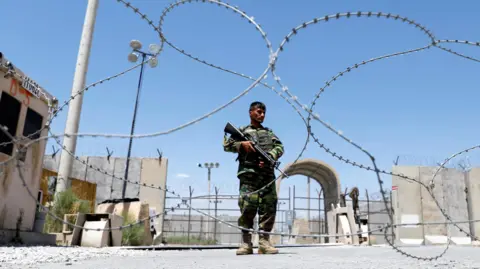
This statement follows remarks by Trump suggesting that retaking Bagram airbase—the epicentre of NATO forces in Afghanistan for two decades—might be possible because they need things from us. The base was handed over to the Afghan military shortly before the Taliban took control of Afghanistan.
Trump stated at a press conference in the UK that the US 'gave it to them for nothing'. This decision was part of a deal established during his presidency in 2020 and executed under President Joe Biden in 2021.
Additionally, Trump claimed he had intended to retain Bagram airbase for strategic reasons related to China, referring to its proximity to locations associated with Chinese nuclear weapons. However, his comments prompted confusion, as credible investigations indicated no significant activity at the base following the Taliban’s return to power and dispelled claims regarding China’s presence at Bagram.
A Chinese foreign ministry spokesman reiterated that China respects Afghanistan's territorial integrity and sovereignty while emphasizing that Afghanistan's future should be determined by its own people. Alongside this, Jalal stated on the social media platform X that historically, Afghans do not accept foreign military presence, standing firm on the matter during negotiations in Doha.
The U.S. and Taliban have been engaging in discussions recently, with particular focus on American citizens still in Afghanistan. As of now, both sides appear to be approaching the situation with diplomatic considerations in mind.

